Trained Models & Pipelines
python -m spacy download en_core_web_smimport spacynlp = spacy.load("en_core_web_sm")import en_core_web_smnlp = en_core_web_sm.load()doc = nlp("This is a sentence.")print([(w.text, w.pos_) for w in doc])Package naming conventions
In general, spaCy expects all pipeline packages to follow the naming convention
of [lang]_[name]. For spaCy’s pipelines, we also chose to divide the name into
three components:
-
Type: Capabilities (e.g.
corefor general-purpose pipeline with tagging, parsing, lemmatization and named entity recognition, ordepfor only tagging, parsing and lemmatization). -
Genre: Type of text the pipeline is trained on, e.g.
webornews. -
Size: Package size indicator,
sm,md,lgortrf.smandtrfpipelines have no static word vectors.For pipelines with default vectors,
mdhas a reduced word vector table with 20k unique vectors for ~500k words andlghas a large word vector table with ~500k entries.For pipelines with floret vectors,
mdvector tables have 50k entries andlgvector tables have 200k entries.
For example, en_core_web_sm is a small English
pipeline trained on written web text (blogs, news, comments), that includes
vocabulary, syntax and entities.
Package versioning
Additionally, the pipeline package versioning reflects both the compatibility
with spaCy, as well as the model version. A package version a.b.c translates
to:
a: spaCy major version. For example,2for spaCy v2.x.b: spaCy minor version. For example,3for spaCy v2.3.x.c: Model version. Different model config: e.g. from being trained on different data, with different parameters, for different numbers of iterations, with different vectors, etc.
For a detailed compatibility overview, see the
compatibility.json.
This is also the source of spaCy’s internal compatibility check, performed when
you run the download command.
Trained pipeline design
The spaCy v3 trained pipelines are designed to be efficient and configurable. For example, multiple components can share a common “token-to-vector” model and it’s easy to swap out or disable the lemmatizer. The pipelines are designed to be efficient in terms of speed and size and work well when the pipeline is run in full.
When modifying a trained pipeline, it’s important to understand how the
components depend on each other. Unlike spaCy v2, where the tagger,
parser and ner components were all independent, some v3 components depend on
earlier components in the pipeline. As a result, disabling or reordering
components can affect the annotation quality or lead to warnings and errors.
Main changes from spaCy v2 models:
- The
Tok2Veccomponent may be a separate, shared component. A component like a tagger or parser can listen to an earliertok2vecortransformerrather than having its own separate tok2vec layer. - Rule-based exceptions move from individual components to the
attribute_ruler. Lemma and POS exceptions move from the tokenizer exceptions to the attribute ruler and the tag map and morph rules move from the tagger to the attribute ruler. - The lemmatizer tables and processing move from the vocab and tagger to a
separate
lemmatizercomponent.
CNN/CPU pipeline design
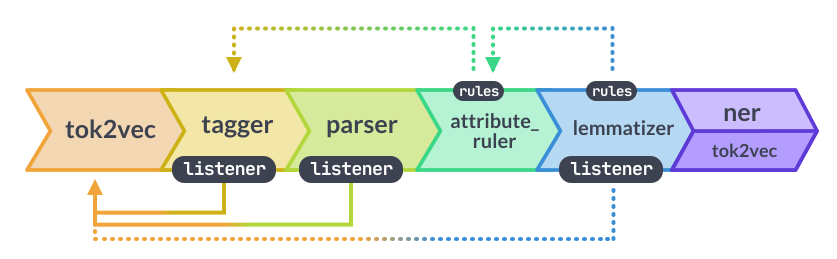
In the sm/md/lg models:
- The
tagger,morphologizerandparsercomponents listen to thetok2veccomponent. If the lemmatizer is trainable (v3.3+),lemmatizeralso listens totok2vec. - The
attribute_rulermapstoken.tagtotoken.posif there is nomorphologizer. Theattribute_ruleradditionally makes sure whitespace is tagged consistently and copiestoken.postotoken.tagif there is no tagger. For English, the attribute ruler can improve its mapping fromtoken.tagtotoken.posif dependency parses from aparserare present, but the parser is not required. - The
lemmatizercomponent for many languages requirestoken.posannotation from eithertagger+attribute_rulerormorphologizer. - The
nercomponent is independent with its own internal tok2vec layer.
CNN/CPU pipelines with floret vectors
The Croatian, Finnish, Korean, Slovenian, Swedish and Ukrainian md and lg
pipelines use floret vectors instead of default vectors.
If you’re running a trained pipeline on texts and working with Doc
objects, you shouldn’t notice any difference with floret vectors. With floret
vectors no tokens are out-of-vocabulary, so
Token.is_oov will return False for all tokens.
If you access vectors directly for similarity comparisons, there are a few differences because floret vectors don’t include a fixed word list like the vector keys for default vectors.
-
If your workflow iterates over the vector keys, you need to use an external word list instead:
-
Vectors.most_similaris not supported because there’s no fixed list of vectors to compare your vectors to.
Transformer pipeline design
In the transformer (trf) pipelines, the tagger, parser and ner (if
present) all listen to the transformer component. The attribute_ruler and
lemmatizer have the same configuration as in the CNN models.
For spaCy v3.0-v3.6, trf pipelines use
spacy-transformers and the
transformer output in doc._.trf_data is a
TransformerData object.
For spaCy v3.7+, trf pipelines use
spacy-curated-transformers
and doc._.trf_data is a
DocTransformerOutput object.
Modifying the default pipeline
For faster processing, you may only want to run a subset of the components in a
trained pipeline. The disable and exclude arguments to
spacy.load let you control which components are
loaded and run. Disabled components are loaded in the background so it’s
possible to reenable them in the same pipeline in the future with
nlp.enable_pipe. To skip loading a component
completely, use exclude instead of disable.
Disable part-of-speech tagging and lemmatization
To disable part-of-speech tagging and lemmatization, disable the tagger,
morphologizer, attribute_ruler and lemmatizer components.
Use senter rather than parser for fast sentence segmentation
If you need fast sentence segmentation without dependency parses, disable the
parser use the senter component instead:
The senter component is ~10× faster than the parser and more accurate
than the rule-based sentencizer.
Switch from trainable lemmatizer to default lemmatizer
Since v3.3, a number of pipelines use a trainable lemmatizer. You can check whether the lemmatizer is trainable:
If you’d like to switch to a non-trainable lemmatizer that’s similar to v3.2 or earlier, you can replace the trainable lemmatizer with the default non-trainable lemmatizer:
Switch from rule-based to lookup lemmatization
For the Dutch, English, French, Greek, Macedonian, Norwegian and Spanish pipelines, you can swap out a trainable or rule-based lemmatizer for a lookup lemmatizer:
Disable everything except NER
For the non-transformer models, the ner component is independent, so you can
disable everything else:
In the transformer models, ner listens to the transformer component, so you
can disable all components related tagging, parsing, and lemmatization.
Move NER to the end of the pipeline
For access to POS and LEMMA features in an entity_ruler, move ner to the
end of the pipeline after attribute_ruler and lemmatizer: